Pre-Budget Briefing #3: Funding Defence
The Chancellor should be able to close the immediate £4.7 billion gap in the Defence Investment Plan. The more significant challenge will be establishing a credible and sustainable route to meeting Britain’s longer-term defence commitments. This article was written by Bradshaw Economics Chief Economic Adviser and former Chief Economist of the Ministry of Defence Andrew Morrison.
John Healey’s first Budget as Chancellor comes with an unusual personal context. In June, he resigned as Defence Secretary, saying that the Defence Investment Plan’s financial settlement “falls well short of what is required for defence and the country at this dangerous time”. A little over a month later, Andy Burnham appointed him Chancellor. He now has responsibility for balancing the case he made for greater defence expenditure against the wider pressures on the public finances.
The immediate issue is a £4.7 billion gap in the funding of the Defence Investment Plan. The plan provides for an MOD budget of £297.7 billion over the four years to 2029-30, including an additional £15 billion announced in June. The Government has so far identified sources for £10.3 billion of that increase. The remaining £4.7 billion is to be confirmed at the Budget, including £1.8 billion required in the current financial year.
Finding this money will not be straightforward in a Budget already constrained by higher borrowing costs, weak growth and demands for additional spending on public services and the cost of living. Government borrowing has also been running above the Office for Budget Responsibility’s forecast.
Nevertheless, £4.7 billion spread over four years is unlikely to be the most difficult part of the defence settlement. The Government will probably assemble it through some combination of additional Treasury funding, further reallocations, asset sales and adjustments to the timing of expenditure. The larger question has effectively been deferred until next year’s Spending Review: how will the Government pay for its commitment to raise defence spending beyond the 2.7 per cent of GDP currently planned for the end of the decade?
The scale of the longer-term commitment
The Defence Investment Plan takes the Ministry of Defence budget to £79.1 billion in 2029-30. On the wider NATO definition, which includes some defence-related expenditure outside the MOD, the Government expects spending to reach 2.7 per cent of GDP in 2027-28 and remain at that level for the following two years.
The Government remains committed to reaching NATO’s core defence target of 3.5 per cent by 2035, but has not set a date for reaching 3 per cent. Healey has said that defence will be “central” to next year’s Spending Review, which will set out a clear path to 3.5 per cent and a target date for reaching 3 per cent.
The published figures provide an indication of the scale of the decision. On the basis of the OBR’s March 2026 forecast for nominal GDP, increasing defence expenditure from the published 2.7 per cent baseline to 3 per cent would require approximately £10.5 billion of additional spending in 2029-30, rising to around £10.9 billion in 2030-31. The published 2.7 per cent figure is rounded: using the underlying figure of 2.68 per cent would produce a slightly higher estimate. The OBR’s earlier estimate of £17.3 billion measured the cost of reaching 3 per cent from the previous, lower spending baseline, before the Defence Investment Plan was published.
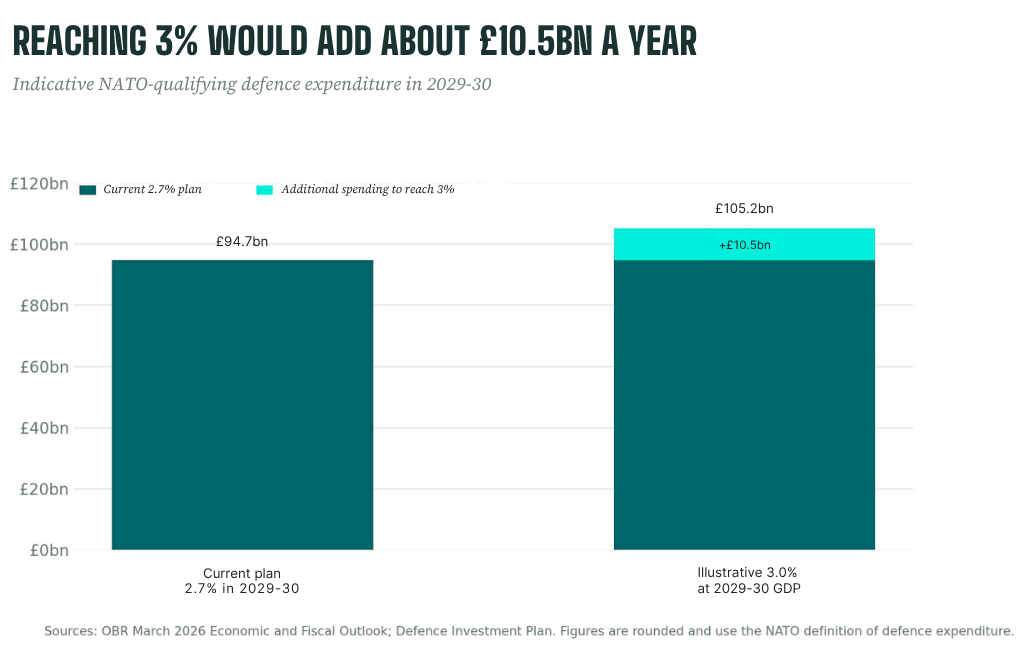
This would be a recurring annual cost rather than a one-off allocation. Once 3 per cent had been reached, the Government would need to provide around £10.5 billion more in the first year than under the published 2.7 per cent baseline, with the cash amount rising thereafter in line with nominal GDP. Maintaining the higher level for five years could therefore involve more than £50 billion of additional expenditure in total, although the precise amount would depend on the timetable for reaching 3 per cent and the future path of nominal GDP.
The distinction between annual and cumulative cost is important. Reaching 3 per cent would permanently raise the annual defence baseline by around £10.5 billion initially, with the cash amount rising over time. The cumulative fiscal cost would then increase for every year that the higher level was maintained.The IFS estimates that reaching the 3.5 per cent NATO target by 2035 would require around a further £25 billion a year in today’s terms, relative to the newly announced plans.
In broad terms, the additional funding would have to come from some combination of higher taxes, lower expenditure elsewhere, additional borrowing or stronger economic growth. All four possibilities present difficulties.
The Government has identified £4 billion from reductions to other departments’ capital budgets, together with proposed reductions in planned expenditure on roads and energy, transfers of some costs from the MOD and assumed receipts from asset sales. Further reallocations would be increasingly likely to affect projects with economic or social benefits rather than expenditure that can readily be regarded as low priority. Significant reductions in day-to-day public services would be more difficult still.
Additional borrowing would reduce the need for immediate tax increases or spending reductions, but could conflict with the fiscal rules and add to concerns in the gilt market. Higher borrowing costs already mean that a greater proportion of public expenditure is being used to service debt. This limits the resources available for defence and other public services.
Stronger economic growth would improve tax receipts and make a higher level of defence expenditure easier to accommodate, although it would also increase the cash expenditure required to meet a target expressed as a percentage of GDP. The Spending Review will need to be based on the OBR’s central economic and fiscal forecast. The Government could not prudently allocate resources on the assumption that growth will be stronger than the OBR expects, although any sustained improvement would ease the choices over time.
Tax increases may therefore form part of the eventual settlement. The Government’s commitments on the main taxes limit its options, however, while smaller measures focused on property, wealth or particular industries may not provide a sufficiently large and dependable source of revenue on their own.
How the settlement may be managed
The Treasury has several mechanisms available to manage the transition to higher defence spending and reduce the immediate pressure on the public finances.
One option is to backload the increase, with relatively modest additions in the early years followed by larger increases as the target date approaches. The Government may also present the settlement as a cumulative multi-year total, rather than placing emphasis on the recurring annual cost.
Further efficiency savings, procurement reforms and asset disposals are also likely to form part of the package. There should be scope for the MOD to improve the way it purchases and manages equipment. However, savings of this kind can be difficult to deliver, particularly when they depend on changes to large and complex programmes. Asset sales provide one-off receipts and cannot support a permanently higher level of annual expenditure.
The Government may also seek to ensure that all eligible expenditure is properly recognised under NATO’s definitions. This can include relevant spending outside the MOD on areas such as intelligence and support for Ukraine, while some resilience and security expenditure may count towards NATO’s separate 1.5 per cent target rather than the 3.5 per cent core defence target. There may be good reasons to recognise these contributions, although doing so does not necessarily provide the Armed Forces with additional resources or capability.
The amount of cash required will also depend on the level of GDP. If GDP is lower than forecast, a given percentage target will require less expenditure in cash terms. But the wider fiscal position would also be weaker, so this would not represent a meaningful improvement in the affordability of defence.
Used appropriately, these mechanisms can help to phase the increase and ensure that defence spending is measured consistently. They are unlikely, however, to replace the need for substantive decisions about taxation, other areas of expenditure and borrowing.
The potential role of private finance
The Government will also argue that increasing defence capability is not solely a matter of allocating additional departmental expenditure. Its forthcoming Defence Finance and Investment Strategy is intended to bring more private capital into defence and enable the public budget to be used more effectively.
The strategy is expected to have three main elements. A new Defence Investment Unit will provide investors and defence companies with a single point of entry into government. The MOD, Treasury and National Infrastructure and Service Transformation Authority are examining new financing models. The Government is also developing a pipeline of investable opportunities capable of attracting banks, institutional investors and public financial institutions such as the National Wealth Fund and British Business Bank.
The intention is to translate the long-term demand identified in the Defence Investment Plan into propositions that investors can assess and finance. Private finance is most likely to be appropriate where an asset or service generates a predictable stream of payments and where the associated risks can be clearly identified and allocated.
Potential applications could include service accommodation, utilities, energy resilience, training and simulation, logistics, digital infrastructure and new industrial facilities. A production plant might, for example, be privately financed where there are sufficiently credible long-term orders from the MOD and allied governments.
Such arrangements could bring forward investment, expand industrial capacity and distribute expenditure over a longer period. They could be particularly helpful where companies are reluctant to invest because the future pipeline of defence orders is uncertain. Private sector involvement may also bring commercial expertise, innovation and more effective management of particular risks.
The relevant comparison is therefore not simply between public and private financing costs. It is whether the complete arrangement offers better value over its lifetime after allowing for financing costs, risk transfer, delivery performance and the Government’s need to retain operational flexibility.
Private finance does not, however, remove the underlying cost. Where investors finance an asset, the Government will generally repay them through future charges, guaranteed purchases or another form of contractual commitment. Private borrowing is normally more expensive than government borrowing, although this may be offset where the private sector is better placed to manage construction, demand, performance or technological risks.
Experience with the Private Finance Initiative was mixed. Some schemes transferred risk effectively and supported the delivery and maintenance of public assets. Others involved inflexible contracts, high financing costs or risk transfer that proved less effective than originally expected. The lesson is not that private finance should be avoided, but that projects should be selected on the basis of whole-life value for money rather than their accounting treatment or their ability to reduce near-term capital expenditure.
The accounting treatment will in any event depend on who controls the asset and bears the principal risks. A privately financed arrangement may still create public sector liabilities or be recorded on the public balance sheet.
Nor is private investment a direct substitute for the additional public spending required to meet the defence target. It can help to finance factories, infrastructure, equipment and services, but it cannot permanently fund personnel or military operations. A pound invested by a pension fund does not automatically constitute a pound of NATO-qualifying UK defence expenditure.
The Defence Finance and Investment Strategy should therefore be assessed against two related tests. The first is whether it expands productive capacity and enables capability to be delivered sooner or more efficiently. The second is whether its whole-life costs, risks and future public liabilities are reported transparently. A strategy that meets both tests could make an important contribution to delivering the defence programme. Its role should nevertheless be distinguished from the separate task of funding the Government’s defence spending commitment.
Bradshaw has already been exploring these questions through the Public Private Partnership Commission, whose first report considers how a new generation of public-private partnerships could mobilise private capital while learning the lessons of earlier PFI models. Those lessons will be highly relevant to defence: the test should be whether new financing structures improve delivery and whole-life value, with risks allocated appropriately, rather than simply moving expenditure away from the public balance sheet.
The Spending Review will be decisive
The Chancellor is likely to identify the remaining £4.7 billion required for the existing Defence Investment Plan. Given the circumstances of his resignation and subsequent return to government, there will be considerable political pressure to ensure that the plan is fully funded.
That will not resolve the longer-term question. The current plan takes defence spending to 2.7 per cent of GDP. Reaching 3 per cent could require around another £10.5 billion in 2029-30, with the cash amount rising thereafter in line with nominal GDP. Maintaining that higher level for five years could cost more than £50 billion cumulatively, before allowing for further progress towards the 3.5 per cent NATO target.
Private investment, changes in the timing of expenditure, broader recognition of eligible defence spending and further efficiencies could all make the transition more manageable. However, these measures principally affect the timing, classification or delivery of expenditure. They do not, in themselves, provide the permanent public funding required to sustain a higher defence budget.
Next year’s Spending Review will consequently require the Government to establish how much of the increase will be funded through taxation, how much will be met by changes to other programmes and whether there is any scope for additional borrowing within the fiscal framework. It will also need to demonstrate that the MOD and the defence industry have the capacity to convert additional funding into usable military capability.
As Defence Secretary, John Healey argued that the resources allocated to defence were insufficient for the security environment facing the UK. As Chancellor, his task will be to determine how a higher and sustained level of defence expenditure can be reconciled with the Government’s wider economic and fiscal objectives.