John Healey’s first budget is approaching, and the room he has to make choices depends heavily on how government spending is made up. A growing share goes on welfare, pensions and debt interest, which the Treasury cannot easily control, leaving less for everything else. This piece explains how the two main categories of spending, Annually Managed Expenditure (AME) and Departmental Expenditure Limits (DEL), differ, why AME is rising and what that means for the Chancellor.
Insights by Cicely Mallinson, Junior Economist
How do we split up government expenditure?
The money spent by the government falls into one of two categories: Annually Managed Expenditure (AME) and Departmental Expenditure Limits (DEL). Together they make up something called Total Managed Expenditure (TME). While they sit under the same umbrella, they both behave very differently from one another and each affect what the chancellor can afford to do in different ways.
AME covers with spending on debt servicing, social welfare benefits, and pensions. It responds to changes in the inflation rate, unemployment, and interest rates, all of which can move at the drop of a hat, making it volatile and hard to manage.
DEL covers the capital and resource spending required by government departments to cover their day to day operations and longer term investment. DEL are set at the spending review, not the b
udget. At each spending review, departments bid into the Treasury for money and are then allocated a fixed capital and resource budget. These budgets are, in theory, locked in once decided and departments are legally blocked from exceeding their allocations without Treasury approval.
In contrast to the essentially fixed DEL, AME changes with external conditions - inflation could be high, meaning upratings to benefits and the triple lock, bond yields could change, affecting borrowing costs - meaning from one budget to the next, the outlook for AME could turn out to be much more or much less of a burden to the chancellor.
The OBR releases their economic and fiscal forecast alongside the Treasury’s budget. It’s that forecast that tells the chancellor how much headroom there is for changes in tax and discretionary spending. If AME is forecast to be larger, then there is ultimately less fiscal headroom for departmental spending, tax cuts or other goals, an issue currently facing Healey, as the costs of living are rising, but greater calls for protected budgets.
How does AME affect government spending?
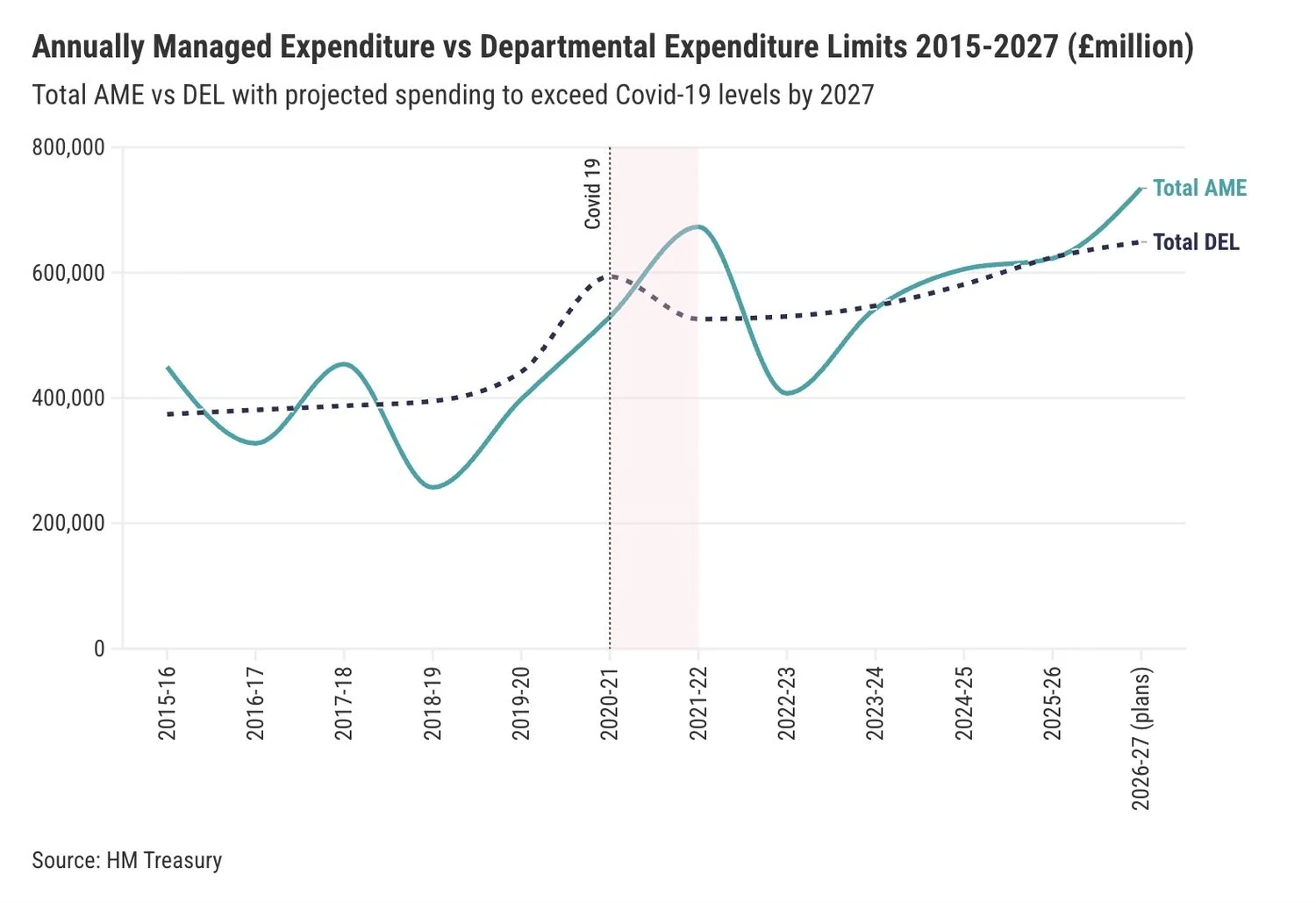
The headroom for departmental expenditures are determined by the requirements of AME, Three pressures stand out.
AME is increasing as a result of more welfare and disability payments, driven in part by greater claims of long-term illness and disability, particularly in the younger working age groups, much of which resulting from increased reports of mental health conditions, especially amongst young people.
Secondly, pensions are increasingly becoming a factor affecting government spending due to the triple lock introduced in 2011. The triple lock was designed to protect pensions and ensure they never fell behind the cost of living, to reduce pension poverty. Pensions are uprated each year by the highest of either inflation, 2.5% and the growth in earnings. Given that the triple lock selects the maximum of these numbers in each year, these triple lock increases compound on one another, meaning that in the long run, pension spending grows faster than both inflation and earnings, constantly pushing up AME in the process.
The third is servicing the debt interest, and it feeds on the first two. Government expenditure is funded through borrowing or taxation. The trouble is more borrowing means a higher debt servicing cost, which pushes AME up again - a vicious cycle.
What does this mean for the Chancellor?
DEL is not up for decision at this budget. Departmental budgets were set at the last spending review and won’t be revisited until the next one in 2027. Healey will be paying much closer attention to the OBR’s AME forecast. Welfare, pensions and debt interest are all pushing AME up, and the higher it goes the less money there will be for departments at the spending review.
Unprotected departments have little left to give. DEL has grown overall, but most of the increase has gone to protected areas such as health, and other departments have been under pressure for years. Healey resigned as Defence Secretary over military spending, but he has now put off his own target of spending 3% of GDP on defence by 2030 until the spending review.
Headroom looks to be falling, mainly because of rising gilt yields. Healey has to weigh how much of a buffer he wants to create for the spending review, given where the AME forecast is heading, against spending on new measures now or holding money back for bigger commitments later.
The government has already acted on pensions. Last month it announced that from April 2030 the triple lock will be replaced by an uprating mechanism without the automatic link to earnings, with the savings going to a National Care Service. Welfare has been harder. Starmer’s government backed down on its reforms in 2025 and spending has kept rising, so Healey will still have to deal with it.